More Posts
-
3 Best House Cleaning Services for Every Budget in 2026
-
Why Your Breaker Keeps Tripping and When You Need Electrical Repair
-
Interior Painting: Costs, Paint Types, Room Sizes, and What to Know
-
10 Home Renovation Ideas That Can Increase Your Home’s Value in 2026
-
Does Your Air Conditioner Repair? 8 Signs, Cost & More
You hit the microwave button, then you start the kettle. Right away, the lights drop out. You walk to the breaker box, open the door, and reset the switch. Then you go back to what you were doing.
But it keeps happening.
A breaker that trips over and over is not just a nuisance. It is your home’s wiring system warning you that there is a fault somewhere. The switch is meant to cut power when it senses trouble, so wires and devices do not get hurt.
The bright side is that a tripped breaker is not always a sign of something big. Sometimes too much is running on one circuit at the same time. At other times, a device may be failing. You might also have worn or damaged wiring, or another electrical problem that needs Electrical repair.
Use the next steps to spot what is going on and figure out what you can check safely.
What Does It Mean When a Breaker Trips?
A circuit breaker is like a guard for an electrical repair line. It monitors the flow of current and checks what is coming through.
When the current rises too much, it reacts. It also acts if the current does not travel where it is meant to. In those cases, the breaker trips. After that, it cuts the power.
This often occurs for reasons like:
- An overloaded circuit
- A short circuit
- A ground fault
- A faulty appliance
- A damaged wire
- A worn-out breaker
Think of it as a warning rather than something you should simply reset and forget.
1. Your Circuit Is Overloaded
A breaker often trips when a circuit has too much load. Each circuit has a limit for current. If you connect too many high watt devices at once, the circuit can go past that limit and the breaker reacts.
Space heaters use a lot of power. So do microwaves and hair dryers. Kettles and portable AC units also pull significant power.
What to do
Pull a few devices off the circuit that seems to be causing trouble. In addition, avoid operating more than one large power appliance within the same time period.
If the breaker doesn’t trip anymore after the load is removed then you likely have identified the problem.
However, if you have to unplug devices regularly to make things work, have your electrician do an inspection. The circuit may need an upgrade.
2. There’s a Short Circuit
A short circuit is a bigger issue. It can start when a hot wire touches a neutral wire. That contact can cause a fast spike in current, and the breaker will shut off right away.
You might see the breaker flip the moment you switch on a certain light, device, or wall switch.
Never attempt to open an outlet or electrical repair box to determine the cause. Wiring that is worn out or damaged can be dangerous, even if you don’t seek it out.
In this instance, the better idea would be to hire a licensed electrician for repairs.
3. There’s a Ground Fault
Ground fault occurs when electricity takes an alternate path to the ground.
That can happen when a hot wire comes into contact with a grounded metal part, or when broken wires come into contact with water.
Ground faults are particularly concerning in areas where water is present, such as:
- Bathrooms
- Kitchens
- Laundry rooms
- Garages
- Outdoor areas
If the breaker trips repeatedly in one of these locations, don’t keep resetting it.
4. A Faulty Appliance Is Causing the Problem
Sometimes the electrical repair system isn’t the problem at all. One of your appliances may be.
When an old or broken appliance develops an internal fault, it could cause the breaker to trip every time the appliance is plugged in or switched on.
Try this simple test.
Turn off and unplug anything on the circuit that is giving you trouble. Then reset the breaker.
Now, plug the devices back in one at a time.
Start with the first one. If the breaker shuts off right after you connect it, take that item out right away. Do not try it again. Wait until a person looks at it or makes a repair.
Doing this can help you find the likely cause without taking apart any electrical gear.
5. The Breaker Itself May Be Bad
Circuit breakers have a limited life. If one gets old or starts to fail, it may trip even when the wiring is not under heavy load. Sometimes people also notice other signs. The breaker may feel wobbly. It might not stay put in the ON position. In some cases it trips over and over, and there is no clear reason.
I would not suggest swapping a breaker on your own unless you are trained to work with electrical repair panels. Inside the panel there can still be live parts. This can be true even if you turn off the specific breaker.
A licensed electrician is able to test the breaker. They can also indicate to you whether or not it needs to be replaced or if something else is happening.
6. Damaged or Loose Wiring
Wires do not last forever. Over the years, the links inside can wear out. They may also come loose. The insulation can get nicked or break down. In some older houses, the wiring may not keep up with what newer appliances need.
Warning signs include:
- Flickering lights
- Buzzing sounds
- Warm outlets or switches
- Burning smells
- Discoloured wall plates
- Breakers that trip frequently
If you see heat or smoke, or if you notice sparks or a burning smell, shut off the power right away. If it is safe to do so, switch it off immediately. Next, call a trained professional as soon as you can.
7. Too Many Extension Cords or Power Strips
Power strips are convenient but they will not increase the amperage capacity of a wall circuit.
Connecting several power strips, or connecting heavy equipment with extension cords, can overload the circuit.
Use wall outlets, if available, particularly for high-energy consuming devices.
No enough outlets for normal daily use? A licensed electrician can check the situation and tell you if more outlets or new circuits are needed.
8. Moisture Is Getting Into the Electrical Repair System
Water and electricity combine for a hazardous mix. A ground fault can be obtained from an outdoor outlet that is damaged or from a leaking pipe in the vicinity of the cables. This can cause the breaker to trip immediately. It is also possible for moisture to ignite it within a bathroom electrical repair box.
Never try to dry or repair a wet electrical repair equipment by yourself.
Stop the leak and dry the wet surfaces. Have a qualified individual inspect the electrical repair system before using again.
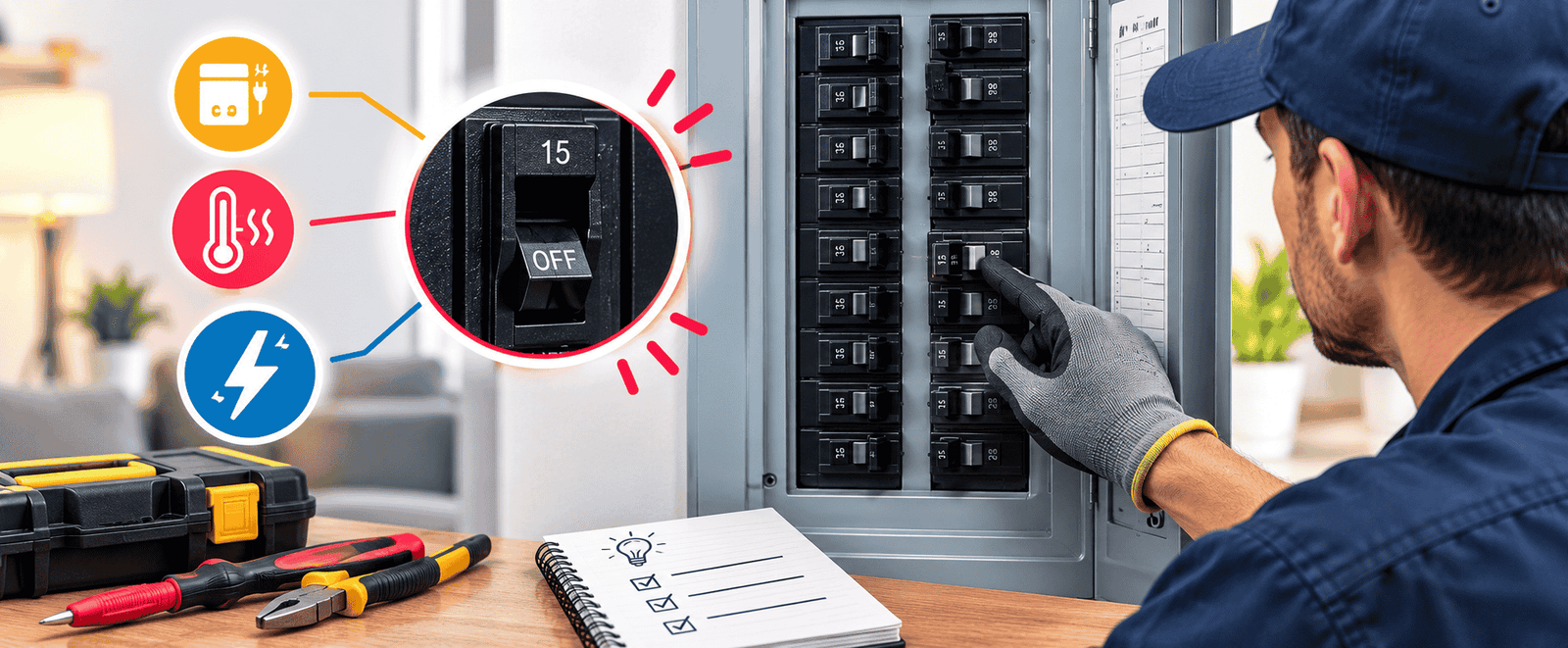
What Should You Do When a Breaker Trips?
If it only happens once after you plug in multiple devices, it can be due to an overload. Start here for a safe check:
- Turn off and unplug appliances on the affected circuit.
- Look for the breaker that is tripped in your Panel.
- Move it fully to the OFF position.
- Move it back to ON.
- Reconnect appliances one at a time.
- Stop if the breaker trips again.
Never attempt to force a breaker into the “ON” position. If it trips immediately with nothing plugged into it, then you may have a larger problem and a licensed electrician should check it out.
When Should You Call an Electrician?
There are some electrical repair issues that aren’t a great idea to do alone. If any of these happen, call a licensed electrician:
- The breaker trips repeatedly
- It trips immediately after being reset
- You smell burning
- You hear buzzing from the panel
- An outlet feels hot
- You see sparks or scorch marks
- Lights flicker frequently
- You suspect damaged wiring
- The problem involves the electrical repair panel
A residential electrician has the right tools and skills. They can find the real cause. They should not just reset the breaker and move on.
How Electrical Repair Maintenance Can Prevent Problems
Before a breaker even trips you can begin to inspect the wiring in your home.
A sound maintenance program can help identify loose wires, worn outlets, circuits that are overloaded, and other potential problems that may become a problem.
If the home is older, if remodelling, if buying large new appliances, or if you are constantly experiencing the same electrical repair issues, you may also consider an electrical inspection.
Simple Electrical Repair Safety Tips
A few habits can make a difference:
- Don’t overload outlets
- Replace damaged cords
- Never allow electrical repair devices to come in contact with water.
- Don’t use power strips to extend power strips
- Never neglect a smell of burning.
- Ensure that the electrical repair panel is accessible.
- Install the proper light bulb wattage for fixtures.
- Do not do complicated wiring repairs.
These simple electrical safety tips matter even more in older homes across Canada. Some of the wiring there was built for fewer devices than people use now.
Why You Shouldn’t Keep Resetting the Breaker
It can be tempting to immediately reset a tripped breaker․
Try not to do that over and over․
Remember‚ the breaker is there to protect you‚ if you’re resetting the breaker and never finding out what made it trip in the first place‚ the problem still exists․
If you have disconnected all devices but the breaker still trips‚ keep it off and call a licensed electrician․
Getting Professional Electrical Repair Help
Without an electrician’s education, you can detect when something is amiss. When a circuit breaker trips frequently, begin by making simple inspections that don’t involve opening any electrical repair boxes. If you still have the issue, then seek out a licensed professional for further investigation.
TapAFix helps you find trusted local electricians, other local home repair services such as Electrical services and beyond—helping you find the right person for the job in the app.
Frequently Asked Questions (FAQs)
How do you fix a breaker that keeps tripping?
If your breaker continues tripping‚ unplug all devices on that line from their wall sockets before resetting the breaker once again․ If the breaker trips again‚ don’t reset the breaker․ Turn the breaker off and have an electrician check the circuit․
Why does my circuit breaker keep tripping?
Most common causes are overload‚ a short circuit‚ ground fault‚ a faulty appliance and a worn breaker․
Should I be worried if my breaker keeps tripping?
Yes․ If your circuit breaker is tripping frequently‚ there may be a home electrical safety issue․ Be careful if you smell burning‚ hear buzzing‚ or see heat and sparks․
How do I find out what keeps tripping my circuit breaker?
To locate the problem‚ unplug everything‚ reset the breaker‚ and reconnect items one by one until the breaker trips․ If it trips even when nothing is plugged into the socket‚ call an electrician․